

Why Your Dryer Takes Too Long to Dry and Why It Is Not Always the Dryer

If your dryer is taking two or three cycles to dry a normal load of laundry, it is easy to assume the dryer itself is failing. Sometimes that is true. A bad heating element, weak gas coils, faulty thermostat, or sensor issue can definitely cause poor drying performance.
But in many homes, the dryer is not actually the main problem.
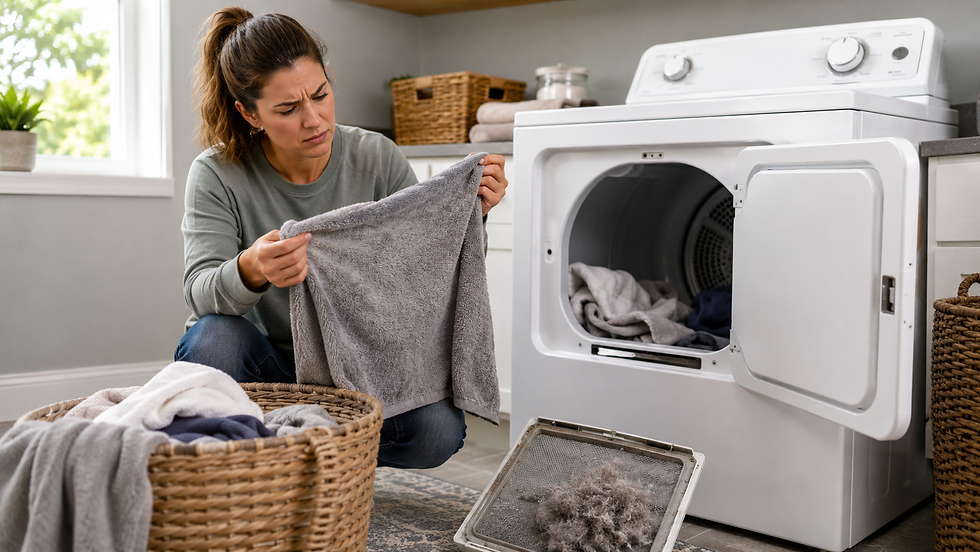
Dryers depend on more than heat. They also need strong airflow. If the dryer cannot move hot, moist air out of the drum and safely outside the home, your clothes will stay damp no matter how hot the dryer gets.
At Expo Appliance, we see this issue often in homes around Lexington, Columbia, West Columbia, Irmo, Chapin, and the surrounding Midlands areas. Here are the most common reasons a dryer takes too long to dry.
A clogged dryer vent
The dryer vent is one of the first things to check when clothes are taking too long to dry.
As your dryer runs, lint, dust, pet hair, and fabric fibers collect inside the vent system. Even if you clean the lint screen after every load, some lint still gets past the filter. Over time, that buildup restricts airflow.
When airflow is restricted, the dryer cannot remove moisture properly. The clothes may feel warm, but they stay damp. You may also notice that the laundry room feels unusually hot or humid while the dryer is running.
A clogged vent can also become a fire hazard, so this is not something to ignore.
A crushed or kinked vent hose
Sometimes the problem is not lint buildup. It may be the flexible vent hose behind the dryer.
If the dryer has been pushed too close to the wall, the hose can become crushed or kinked. This restricts airflow just like a clog would.
This is especially common after a new dryer is installed, after flooring work, or after the dryer has been pulled out and pushed back into place. The dryer may look fine from the front, but the vent hose behind it may be blocking proper airflow.
A long or poorly routed vent run
Some dryers have short, simple vent paths that go directly through the wall. Others have long vent runs that travel through the wall, attic, crawlspace, or roof.
The longer the vent run, the harder the dryer has to work to push air outside. Too many bends, turns, or elbows can make the problem worse.
In some homes, the dryer itself may be working normally, but the vent design makes drying slower than expected. This is one reason proper installation matters.
A dirty lint screen or lint screen housing
Cleaning the lint screen after every load is important, but the area around the lint screen can also collect debris.
Fabric softener sheets can leave a residue on the screen that reduces airflow. If water does not pass through the screen easily when you rinse it, airflow may also be restricted.
Lint can also build up down inside the lint screen housing. When that happens, the dryer may not breathe as well as it should.
Overloading the dryer
A dryer needs space for clothes to tumble. If the drum is packed too full, hot air cannot move evenly through the load.
Large loads of towels, bedding, jeans, or heavy clothing may need more time than lighter loads. But if every load takes multiple cycles, there is probably another issue.
For best results, avoid stuffing the dryer completely full. Clothes should be able to tumble freely.
Washer spin problems
Sometimes the dryer gets blamed for a washer problem.
If the washing machine is not spinning clothes out properly, they go into the dryer wetter than they should. That extra water means longer drying times.
This can happen because of an unbalanced load, drain issue, weak spin cycle, worn suspension parts, or washer error. If clothes feel unusually heavy or dripping wet when they come out of the washer, the washer may need attention.
A heating problem inside the dryer
Of course, the dryer itself can still be the issue.
Electric dryers may have a failed heating element, thermal fuse, thermostat, control issue, or wiring problem. Gas dryers may have weak gas valve coils, ignition problems, flame sensor issues, or other burner-related failures.
A dryer with no heat at all is usually obvious. But a dryer with weak or inconsistent heat can be harder to diagnose. It may heat at first and then stop heating partway through the cycle.
Moisture sensor issues
Many modern dryers use moisture sensors to decide when clothes are dry. If the sensors are dirty, coated with residue, or not reading properly, the dryer may shut off too early or run incorrectly.
This is especially common when using automatic dry cycles. If clothes are still damp at the end of an automatic cycle, but dry normally on timed dry, the moisture sensing system may need to be checked.
Signs your dryer may need service
You may need professional dryer service if:
Clothes take more than one cycle to dry
The dryer gets hot but clothes stay damp
The laundry room feels hot or humid during drying
The dryer shuts off before clothes are dry
Clothes come out unusually hot
There is a burning smell
The outside vent flap barely opens while the dryer is running
The dryer has no heat or inconsistent heat
The dryer is making new or unusual noises
Do not ignore slow drying
A slow dryer is more than an inconvenience. It can waste electricity or gas, wear out your clothes faster, and put extra strain on the appliance.
If the issue is caused by poor airflow, it can also create a safety concern. Restricted dryer vents are one of the most important dryer-related problems for homeowners to take seriously.
Need help with a dryer problem?
If your dryer is taking too long to dry, Expo Appliance can help diagnose the issue. We service dryers in Lexington, Columbia, West Columbia, Irmo, Chapin, Cayce, Blythewood, Elgin, and nearby areas.
Whether the problem is the dryer, the vent, the washer, or the installation, our technicians can help find the cause and recommend the right solution.


